
The Tower
Pathway to the divine, Perspective shifter, and Security Maker

Pervasive in our collective conscious and unconscious, towers loom above us in all of the inhabited places of the world. Whether concrete and steel, inviting tourists to the top of their ever increasing heights in the largest of metropoles, or the tanned beige of rattan rising up among rich greenery in rural villages that may never see a stranger, towers are there as testaments to the human need for the “long motif” and the meaning we make of it. The symbol of the tower is unique in that the inspiring light and the terrifying darkness of its unconscious meaning is tangibly present in our daily experience of the world. In cities around the world you can pay good money to be strapped in and dangled off the edge of the highest peaks to glory in humanity’s conquering of the forces of god, nature and your own access to ample disposable income, while prison towers and the windowless facades of secretive government institutions remind us of the constant struggle for power we are but small parts of.
Pathway to the Divine
Growing up in upstate New York, the drive south on interstate 87 towards Manhattan was a regular one. A relatively repetitive, but beautiful drive of open fields, rocky cliff faces, and clusters of ash, oak, and pine. Squeezed in among too many siblings in the back seat, deviceless in the pre-smartphone era, we’d watch this pattern of field, cliff, tree repeat itself over and over, waiting for the moment when the pattern would break. At a certain bend of the road, at a certain clearing, our breath would catch and we’d push and shove our faces as close to the right side window as we could- because there, in the distance, was Manhattan.
Even from a distance, from across the Hudson and the earth between, the skyline of Manhattan can stun. Surprisingly small, but endlessly tall, the Empire State, the Chrysler, and at the time, two twin towers gave New York City an emerald city allure to the suburban children clawing their kin to get just a peek. The lights, spanning the small island and then climbing inconceivably up, spoke of frenetic action, things happening in stark contrast to the steadfast immobility of the darker outline of trees against an already black sky. For suburban children, accustomed to lives operating on straight, horizontal lines- driving from point a to point b and back again on repeat, casting the eyes up created possibility and expanded worlds. There is mystery, wonder, and awe at the top of a tower. There is a call to action and a dare, that promises something unknown if you choose to accept.
This is not a phenomenon unique to the suburbs or to the modern iteration of tower, the skyscraper. From The Women’s Dictionary of Symbols and Sacred Objects:
The long, vertical motif suggests upward aspiration rising above its own foundation in the earth, which now serves only as a support for the upward movement.
Belltowers and frescoed ceilings adorn centuries old Catholic cathedrals. Buddhist stupas and pagodas, already vertical structures, are often built on mountain peaks. In contrast to modern day towers designed to signal humanity’s active potential and scientific mastery over natural force, places of worship use the long motif to both remind humanity of their connection with and the need to humble oneself in the presence of the divine. By drawing our attention upward and away from the earthly, we are reminded of the temporality of our place on earth and of the mystery we are still too small to know.

Two stories, one from the mythology of the Pare (northern Tanzania) tradition and one from the Luba (Dem. Republic of the Congo) tradition, emphasize the importance of humility in the face of mystery and the divine. In both traditions, humanity had once lived happily amongst the gods, before typical and constant human misbehavior had us cast out from the divine home and placed on Earth. Seeking to return to the divine, towers of unimaginable height were built and the strongest of people were sent to climb the tower and plead the case of the humans. As one might imagine, the gods (Kalumba of the Luba mythology and Kiumbi of the Pare) were not pleased with this circumvention of their will and the imminent intrusion, so they destroyed the tower as the humans attempted to scale its heights and sent them plummeting back down to earth.
In these stories, we recognize the tower as the symbol for the universal and human searching for something greater and our wish to wrest back control and significance in the face of this mystery.
Tower as Far Sight
Incomparably beautiful mortal Psyche has broken her marriage vow to never look upon the face of her husband Eros, son to the goddess of love and beauty, Aphrodite. Spurred on by her jealous sister’s warnings that this secrecy must be due to some monstrosity, Psyche, under the light of an oil lamp, looks upon him as he sleeps. Instead of a monster, she finds a man so beautiful that her hands shake and she spills a drop of oil on his exposed skin. In pain and fury at her betrayal, Eros storms home to his mother to nurse his wounds. To win back his love, Aphrodite, perpetually jealous of beauty amongst mortals, issues Psyche four impossible tasks as penance. Despite her perseverance, the futility of these tasks begins to overwhelm her and Psyche climbs a tower, prepared to take her own life.
Before she can leap, the tower begins to speak, giving her clear instructions on how she must go about completing her final, most terrifying feat.
highlights from the Greek myth of Eros and Psyche
At the top of Cronomer Hill, in a large town just north of New York City, there is a fire tower. It is an easy, but pretty hike to reach it and once you’ve completed this small sacrifice and climbed to the top, you have an expansive view of the Hudson River and the soft, rolling mountains of the Hudson Highlands. As you make the climb, you will read initialed declarations of love, see a variety of sketches of the male genitalia, and step over plenty of empty beer cans. Less common, but equally striking, are the gentle admissions of pain and the proclamations of wisdom that are etched in black sharpie or cut with pocket knife into the wood between two penises. Fuck everything. One reads. You only got you. Another. The height of the tower provides distance, perspective and clarity for those feeling overwhelmed by the weight of it all. The physical act of climbing, the demand to use your earthly body, is a reprieve from the chaos of an overthinking brain. At the top of the tower, constant breeze and full silence commands your attention to look out, farther than you imagined you could, and keeps your eyes locked on a horizon full of detail only slowly coming into view. A focused attention on the present, on the world around you leads to insights that may not have been possible by simply thinking things through.
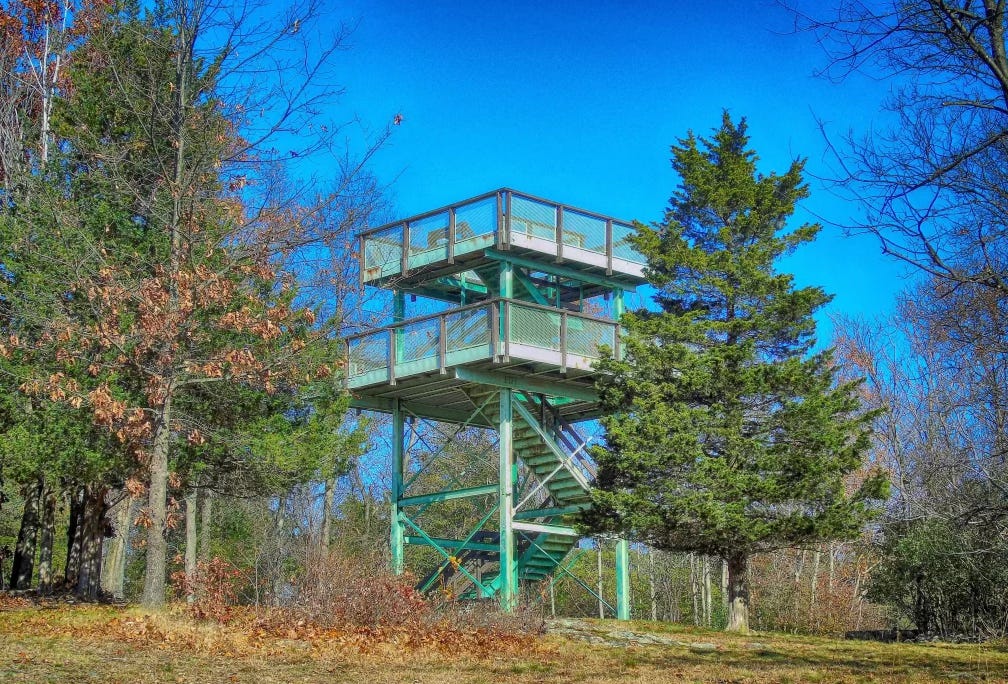
Sudden clarity at the top of the tower, as Psyche and the lonely souls of Cronomer Hill experience, is a motif that likely rings true for many. Psyche was tasked with four impossible feats- to separate a huge mound of barley, wheat, and millet, to shear some wool from a vicious ram, to gather water from the deathly River Styx, and finally, to steal a jar of beauty cream from the queen of the underworld herself, Persephone. In each task, Psyche is helped by wisdom from a divine helper, wisdom which when compounded should empower Psyche to complete the tasks independently. In the middle of the exhaustion, fear, and frustration though, she is unable to integrate and apply these gifts. It is only when climbing the tower, in her solitude, that she is able to hear the necessary guidance.
The tower suggests the need for a different kind of far-seeing view, one of patient endurance in solitude, which may feel like imprisonment.
The Book of Symbols, Taschen
From Psyche, we learn to find lessons in the darkest challenges we face. We gather our own guidance, that when life is at its most impossible, we must climb the tower and turn inward to let the wisdom emerge.
Tower as Security
But of course, on the other hand, for those who can still contrive to live within the fold of a traditional mythology of some kind, protection is still afforded against the dangers of an individual life; and for many the possibility of adhering in this way to established formulas is a birthright they rightly cherish, since it will contribute meaning and nobility to their unadventured lives, from birth to marriage and its duties and, with the gradual failure of powers, a peaceful passage of the last gate.
The Masks of God, Joseph Campbell
Friends of mine who were raised similarly in working/middle class communities of the early 90s often joke that, growing up, they believed there were about 5 career options available to them: maintenance, cosmetology, teacher, doctor, or lawyer. Similarly 25 seemed impossibly old and a life of partnership, career, and children would be firmly established by that point. These were not our rules, but the rules we picked up as we observed the world around us, as we watched a revolving door of our peers and siblings follow this small, yet comfortable path. This was, as Joseph Campbell calls it, our traditional mythology of what it was to live a human life. These milestones did not seem choices, but more rites of passage one had to participate in to be considered successful in moving through this well mapped life.
There were of course exceptions. Uncles you only saw at holidays and who smelled strongly of smoke. Aunts who always brought large bottles of wine and no cousins to play with. These relatives, when spoken about at all, were spoken about with either a slight roll of the eye, lowered whisper of shame, or clenched jaw of concern. They were selfish, incompetent, or troubled- they had to be to so thoroughly fumble their way on the path. These reactions served a crucial function as fence posts, a way to keep folks from straying out into the woods.
Symbolically, the tower represents these traditional mythologies written by cultures to preserve tradition and to keep people in line. For thousands of years, towers have been the markers of civilization. Travelers journeying through forest and field would glimpse a tower and know safety was near. Towers marked the meeting of ancient city walls, allowing guards from within to keep watch against the dangers seemingly always lurking without.
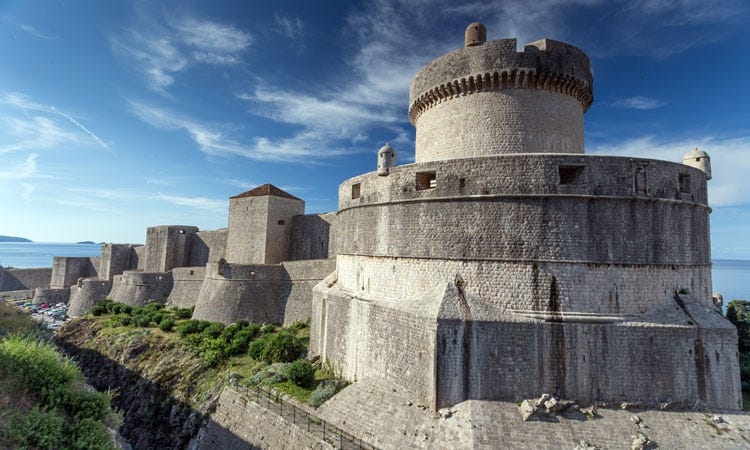
Symbolically, these towers of strength have become the structures of society, where it’s organizations protect us from the return of chaos that always seems to threaten at a distance. Anything beyond was wilderness.
The Book of Symbols, Taschen
Rules governed within the walls, allowing those within to recognize who belonged and who posed a threat. Order was kept in this way and the pattern persists, because there is safety within the structures provided. It is not easy to forge your own path. It requires a surplus of imagination to imagine ways of being that have not been shown to you before and a stronger backbone than most to reject the established markers of success that assure you you are doing this right. There is comfort, too, in following established tradition. There is a connection to the past, a reminder of a larger story, in saying words repeated for millennia and a sense of continuation in knowing there will be others repeating after you. Maybe this is why some try so hard to make others follow the rules. And, there is of course loneliness when making it up as you go.
See you soon
The symbol of the tower invokes both the highest aspirations and darkest impulses among humans. In its positive disposition, it reminds us of our small part in a larger mystery, offers clarity and retreat from chaos, and provides structure in a chaotic world. In this way, the tower is a powerful symbol to anchor to in the endeavor of building new worlds and living authentic lives worth living.
In the next post, I’ll dig more into the shadow aspect of the Tower and how we might work with this powerful symbol. XX.
Things read and listened to
African Mythology A-Z, Patricia Lynch and Jeremy Roberts
The Book of Symbols, Taschen
The Masks of God, volume IV: Creative Mythology
A Women’s Dictionary of Symbols and Sacred Objects, Barbara G. Walker
World Mythology in Bite-Sized Chunks, Mark Daniels